Dead Sea Scales™ · The 5 Missing Notes · By Christopher Dean
The 7 Diatonic Modes
Now let's get into Relative Modes
(The remainder of this section will deal with the relative modes in the key of F Major)
Let's dispel some mysticism. A "relative mode" is just a different pattern of the same grouping of notes. In this example, the seven patterns of the Major scale are all accessible by taking the first note of any pattern and moving it to the end, unlocking the next pattern (See below, this image helped me the most to understand how the modes "relate" to each other).
1 Octave Patterns
Dispelling the Mysticism
A "relative mode" is simply a different pattern using the same grouping of notes. In our F Major example, all seven mode patterns are accessible by taking the first note of any pattern and moving it to the end—this unlocks the next pattern. The cascading diagram below shows exactly how the modes "relate" to each other.
Understanding this connection is the key to mastering all seven modes.
1️⃣ Major Scale (Ionian Mode)
Shown above in the key of F Major (Ionian shape). Play this over and over until you are familiar with the shape with little to no mental effort.
The Major scale typically has a happy sound due to the 3rd note being two whole-tones away from the root. You know this as Solfège: Do-Re-Mi-Fa-Sol-La-Ti-Do.
Pattern:W W H W W W H — Note the location of the 3rd, 6th, and 7th scale degrees.
2️⃣ Minor Scale (Aeolian Mode)
Shown above in the key of D Minor (Aeolian shape). Play this over and over until you are familiar with the shape with little to no mental effort.
The Minor scale typically has a sad sound due to the 3rd note being a whole tone and a half-step away from the root. This inserts a half-step interval, creating tension.
Pattern:W H W W H W W — Note the location of the now flattened 3rd, 6th, and 7th scale degrees.
The Cascading Pattern: How Modes Relate
All 7 Modes in F Major - 2 Octaves
How to Practice These Patterns
1. Take it one mode at a time. Don't overwhelm yourself. Review each pattern individually and get comfortable with it before moving to the next.
2. Always start and end on the RED note. That is the root note of the mode and will preserve the overall feeling and character of the mode.
3. Notice the connection between modes. As each pattern travels past the second octave (ending on the highest RED note on the B string), the continuation of the pattern on the high e string shows the first three notes of the next mode. For example, with F Ionian starting on the low E string, you can see the G Dorian pattern beginning on the high e string. This is the glue that ties the modes together—the last three notes in one pattern are the first three notes in the next.
4. Challenge yourself to stitch patterns together. Once you're comfortable, try starting the Ionian pattern at the octave (around the 13th fret area) and see if you can connect it to the rest of the patterns moving up the next octave. This will help you see the modes as one continuous system across the entire fretboard.
Mnemonic to remember the order: "I Don't Pick Lyrics My Aunt Loves"
Ionian (Major Scale)
W W H W W W H
Vibe: Happy, bright, uplifting
Example: Star Wars - A New Hope theme
Key Feature: Major 3rd (two whole steps from root)
Dorian
W H W W W H W
Vibe: Minor with a brighter edge
Example: Avengers theme
Key Feature: Natural 6th (compared to Aeolian)
Phrygian (Spanish Minor)
H W W W H W W
Vibe: Dark, exotic, Spanish flavor
Example: Metallica - "Wherever I May Roam"
Key Feature: Flat 2nd creates immediate tension
Lydian
W W W H W W H
Vibe: Dreamy, floating, ethereal
Example: The Simpsons theme
Key Feature: Raised 4th creates tension and brightness
Mixolydian
W W H W W H W
Vibe: Bluesy, funky, rock
Example: "Sweet Home Alabama"
Key Feature: Flat 7th creates bluesy flavor
Aeolian (Natural Minor)
W H W W H W W
Vibe: Sad, melancholic, emotional
Example: "Stairway to Heaven" verse
Key Feature: Minor 3rd, flat 6th and 7th
Locrian
H W W H W W W
Vibe: Unstable, tense, unresolved
Example: Metal riffs, horror soundtracks
Key Feature: Diminished 5th (tritone) - the "devil's interval"
Parallel Modes (Modal Neighbors)
Know what mode is a string above or below where you're playing:
Dead Sea Scales™ · The 5 Missing Notes · By Christopher Dean
How to Make the Modes
The following patterns show you how similar the modal shapes really are. By understanding the movement patterns,
you can shift into any mode while staying in one position on the neck. This section demonstrates the relative relationships
between modes - each showing the minimal note changes needed to transform one mode into another.
Turning Major to Minor
The relationship between Major (Ionian) and Minor (Aeolian) is simple: flatten the 3rd, 6th, and 7th notes. These three movements transform the bright major sound into the darker minor sound.
Ionian → Aeolian: Lower the 3rd, 6th, and 7th degrees — transforms bright major into natural minor. The foundation of modal thinking.
Major-Based Modes (Ionian Family)
Ionian → Lydian: Raise the 4th degree (#4) — creates a bright, dreamy, floating quality. Ionian → Mixolydian: Lower the 7th degree (♭7) — adds a bluesy, dominant feel to the major sound.
Minor-Based Modes (Aeolian Family)
Aeolian → Dorian: Raise the 6th degree (M6) — adds hopeful brightness to the minor sound. Aeolian → Phrygian: Lower the 2nd degree (♭2) — creates a Spanish/exotic, dark sound. Aeolian → Locrian: Lower the 2nd AND 5th degrees (♭2, ♭5) — unstable, tense, rarely resolved.
Dead Sea Scales™ · The 5 Missing Notes · By Christopher Dean
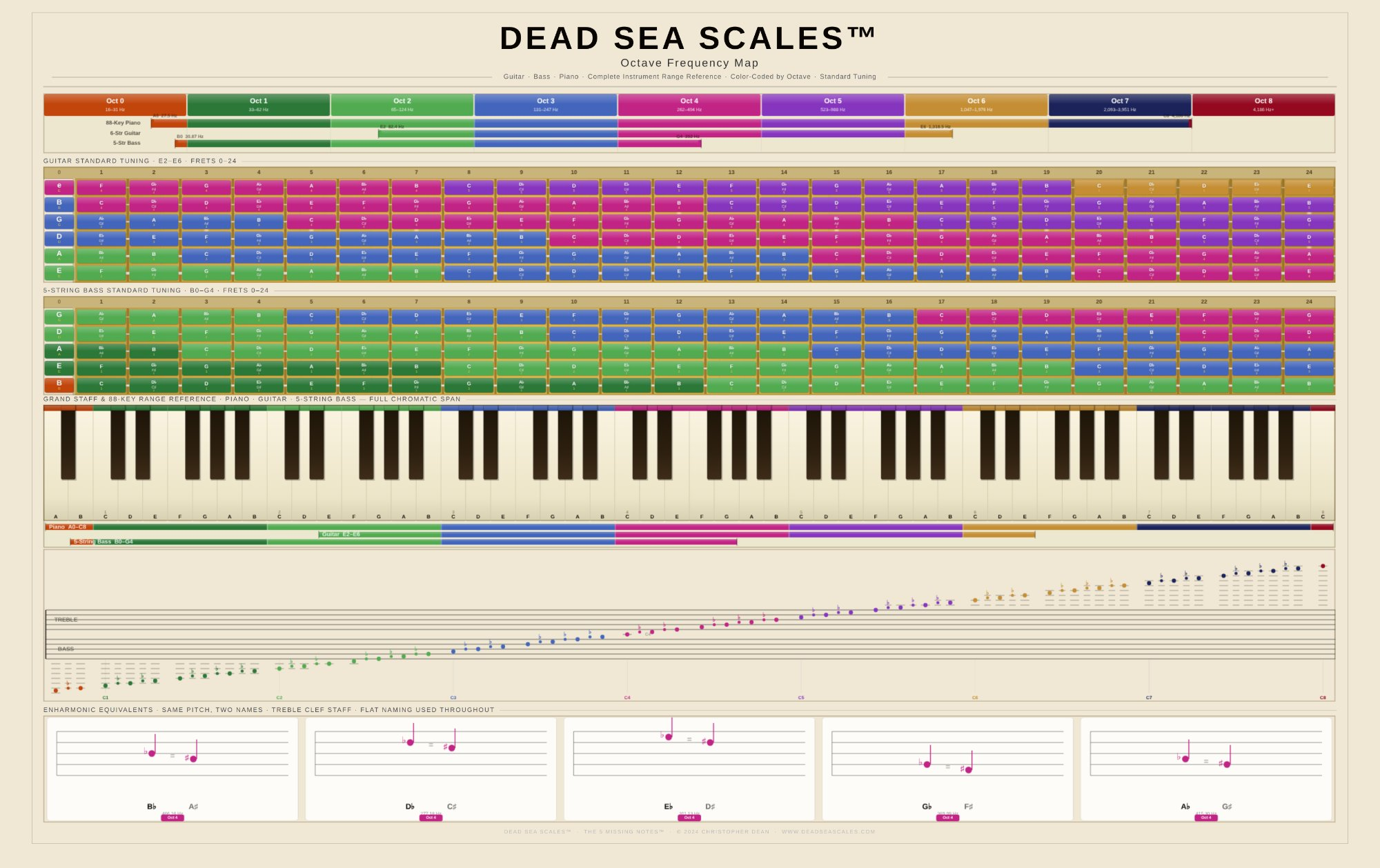
This map is a complete visual reference for the frequency range of guitar, bass, and piano — showing every note across the full playable range of each instrument, colour-coded by octave. Each colour represents a single octave, shared across the piano strip and the fretboard below it, so you can instantly see where the ranges of each instrument overlap, diverge, and meet.
88-Key Piano
A0 → C8
27.5 Hz — 4,186 Hz
7¼ octaves. The broadest range of any common instrument — spanning from the lowest orchestral register to the upper limits of human hearing sensitivity.
6-String Guitar · Standard Tuning · 24 Frets
E2 → E6
82.4 Hz — 1,318.5 Hz
4 octaves exactly. Open low E string to the 24th fret of the high e string. Sits entirely within the middle register of the piano, octaves 2 through 6.
5-String Bass · Standard Tuning · 24 Frets
B0 → G4
30.87 Hz — 392 Hz
A little over 3½ octaves. The open low B string descends near the bottom of the piano keyboard, overlapping with the guitar range from E2 upward.
How to use this map
1Read the octave legend — each colour corresponds to one octave, shared across the piano strip and every matching fret cell below it.
2The piano strip shows the full range of each instrument. Note names and octave numbers are labelled on each key.
3The fretboard maps every fret (0–24) across every string. Each cell shows note name and octave. Enharmonic notes are shown on two lines.
4Use the colour match between piano and fretboard to locate the same note in two places — e.g. trace where C4 (blue) appears on the piano strip, then find every C4 on the fretboard.
5Scroll horizontally within each panel to explore the full 24-fret range. Fret numbers appear in gold at the top of each column.
Octave →
Guitar
Standard Tuning · E2 – E6 · Frets 0 – 24
← scroll to explore →
5-String Bass
Standard Tuning · B0 – G4 · Frets 0 – 24
← scroll to explore →
Grand Staff & 88-Key Range Reference
Piano · Guitar · 5-String Bass — Full Chromatic Span
Dead Sea Scales™ · The 5 Missing Notes · By Christopher Dean
Quick Reference Flashcard
Tap through all the terms · auto-plays every 5 seconds
Terms to Know
Foundational vocabulary for Dead Sea Scales™ — read once, reference forever.
What is Dead Sea Scales™?
In a world of complex problems, search for some simple solutions. Dead Sea Scales is the system created to study shapes instead of sharps — a way to use the classical view of music with a modern approach intended for the fretboard point of view. Utilizing a blend of micro-learning and mind-mapping techniques, we use the scale degree or interval names of the pattern to discuss the function of each note and how it affects the listener and composer. Most of the focus uses the classical theory tool called Movable Do Solfège to explain the guitar neck — showing you the easiest way to know exactly where you are and where to go, all based off the major scale.
What are the 5 Missing Notes™?
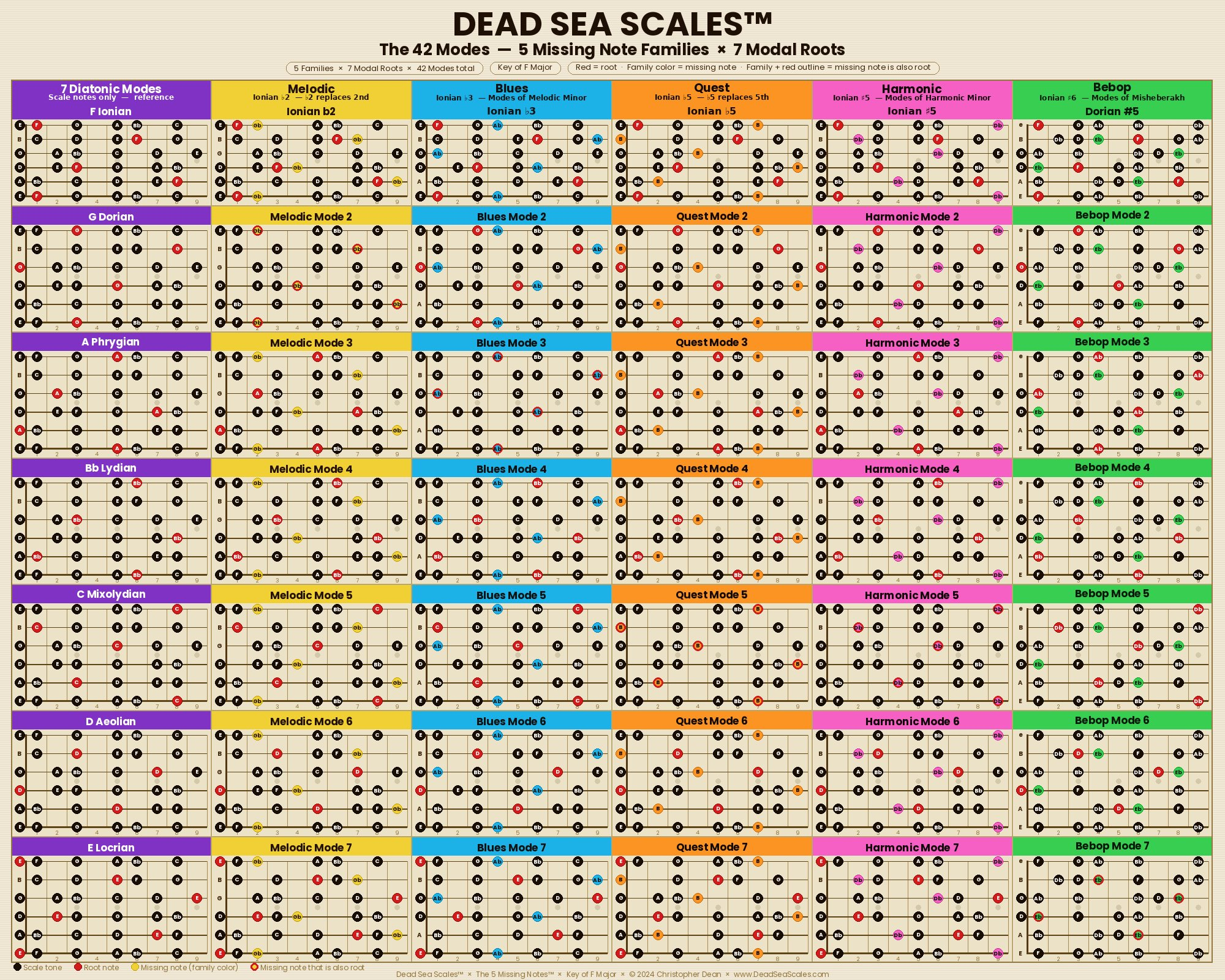
Western music has twelve possible notes. 5 Missing Notes™ identifies the five remaining notes that aren't being played when the seven notes of the major scale are. Any major scale has 7 notes and 5 unplayed notes: 12 − 7 = 5. Playing the C major scale (C, D, E, F, G, A, B), the missing notes would be C#, E♭, F#, G#, B♭ — also known as the black keys on a piano.
What is Music Theory?
Music theory is just that — a theory. Most of the information is every musician that came before you trying to tell you the types of sounds they like. The official definition is "the study of the practices and possibilities of music." The purpose is to understand rhythm, timing, melody, and harmony. The objective: play notes at the same time as other musicians and have it sound good. These are guidelines and starting points. All the scales in the world are hidden within one of two possible shapes on the fretboard with only a slight variation — it's all about where you start and how you look at it.
What is a Note / Tone?
Most of the time these terms are interchangeable, but to be specific: a tone is a pitched musical sound (what you hear) and a note is a written symbol representing that sound (what you see on paper). Music consists of multiple tones or vibrating frequencies played for a duration of time. Notes are called by an alphabetic letter (A–G) and span many octaves. A typical guitar has four octaves. When playing the first or root note, it's called the tonic (main tone).
The Musical Alphabet
There are only 12 notes:
A
A#/B♭
B
C
C#/D♭
D
D#/E♭
E
F
F#/G♭
G
G#/A♭
The sequence repeats over and over moving up and down. Notes 2, 5, 7, 10, and 12 have two names — we can call these “two-faced notes”, or classically, enharmonic notes. For example: A, B♭, C, D, E♭, F, G or A, B, C#, D, E, F#, G# — same notes, different names. They are easily seen as the black keys on a piano, but on guitar they're hidden among the others. Classical theory has rules about naming them because of the elegance of writing on the musical staff — this doesn't apply to guitar the same way. You can call a note whatever you want; it's the distance, or even the silence between the notes, that matters most.
Whole Step & Half Step
These are movement lengths. A whole step (whole tone) is located two frets away from the starting note. A half step (semitone) is only one fret away. A scale can be described as a series of whole steps and half steps (e.g. W W H W W W H for the major scale).
Four Ways to Discuss a Note's Location
By the letter name (e.g. A, C)
By the scale degree / interval name (e.g. minor 2nd, Major 3rd)
By fretboard location (e.g. 5th fret on the A string)
By movement in whole steps (W) or half steps (H) from the current note
What is Tuning? What is A440?
To tune a guitar you tighten a string (raising pitch) or loosen it (lowering pitch). Standard tuning from thickest to thinnest string: E A D G B e. We measure sound in Hertz (Hz). The agreed standard is tuning the A above middle C (A4) to 440 Hz. A440 is located on the 5th fret of the high (e) string — and its octave, A880Hz, is on the 17th fret of the same string, exactly twice the frequency. Middle C (C4) is referred to as such due to its location on the musical staff and its position near the center of most pianos — sound moves into infinity in both directions, so we choose a center starting point. There are alternate tunings for guitar — most keep the same interval relationships as standard, while open tunings stray further from it. In Dead Sea Scales we stay in standard A440 tuning.
What is Pitch?
"Pitch" describes a sound in low or high frequency. A bass guitar is lower in pitch than a guitar; keys on the right of a piano are higher than those on the left. As we move from one note to another, we are changing pitch.
What is a Chord?
A chord is the common term for more than one note played at the same time — usually 2–6 notes. Most examples are three notes of a scale known as a triad.
What is a Triad?
Triads are any grouping of three notes within a scale. The most common triads use the 1st, 3rd, and 5th degrees of the scale. Some notes can be substituted creating a suspended chord. Two-note chords are called diads — the most common is the power chord.
What is a Power Chord?
A power chord is the foundation of most modern music. It uses only two different notes: the root note and the 5th degree. Typically played with your index finger on any note and your ring finger two frets higher on the next string up (e.g. index on 3rd fret Low E, ring on 5th fret A string = G power chord).
What is Rhythm?
Rhythm is the length and duration of notes played in music — a pattern in time, usually regular and repeating. The clearest examples are the drums of AC/DC and The Beatles, keeping a solid 4/4 groove that provides a canvas for melody to paint upon.
What is Timing?
Something must align musicians and sync them up. In music this is accomplished by either a metronome or the drummer. The constant reference point tells all musicians they need to match their hits to the reference — unless the part specifically calls for complex rhythm that requires straying off-time.
What is a Melody?
Melody is best described as a combination of pitch and rhythm performed in a linear succession. Usually an overlay to an underlying chord progression, creating a complete picture for the listener. Sometimes the lead melody adds occasional harmonies expanding the landscape.
What is Harmony?
Harmony is the concept of combining different sounds together to create new, distinct musical ideas. It tends to be a musical interval counterpoint note — typically another modal position played on top of the existing melody notes.
What is an Interval?
The standard musical definition is "the distance between two points." Your roadmap of what you just played, what you're playing now, and what you're playing next. Each scale or pattern of notes paints a landscape of emotions depending on your speed, pattern, and feel. The note you hit, how you hit it, and where you go next is all it really comes down to. For example: play the 1st fret note on any string, then the 2nd fret, then the 3rd — that's a movement of a minor 2nd interval, moving up by half step at a time. The term “feel” is used by theorists to denote the smoothness of a player's bends or transitions between notes. As they say: “Timing is everything” — and that is especially close to law in every aspect of music.
What is Solfège?
The syllables Do Re Mi Fa Sol La Ti Do are assigned to the notes of the major scale. There are two main types: Fixed Do keeps "Do" on the note C. Movable Do relocates "Do" to the tonic or relative major root note. In Dead Sea Scales examples, "Do" is placed on F throughout the images.
What is a Scale?
A scale is a series or pattern of notes played in succession, one after another. Most scales used today are the same notes played ascending and descending (with occasional exceptions like melodic minor). The key of a scale is determined by the starting/ending note of the pattern.
What is a Mode?
A mode is a scale played from a different clock position of the original scale. Instead of playing C D E F G A B C over a C chord, play D E F G A B C D — this is the Dorian Mode, starting at the 2nd note of the pattern. The Diatonic Modes are made up of seven of the twelve possible notes. The root position is the Major Scale — also known as the Ionian mode. The seven notes create seven possible starting points, each painting a different emotional landscape. The complicated Greek names (Phrygian = Phrygia, etc.) are simply named after ancient cities.
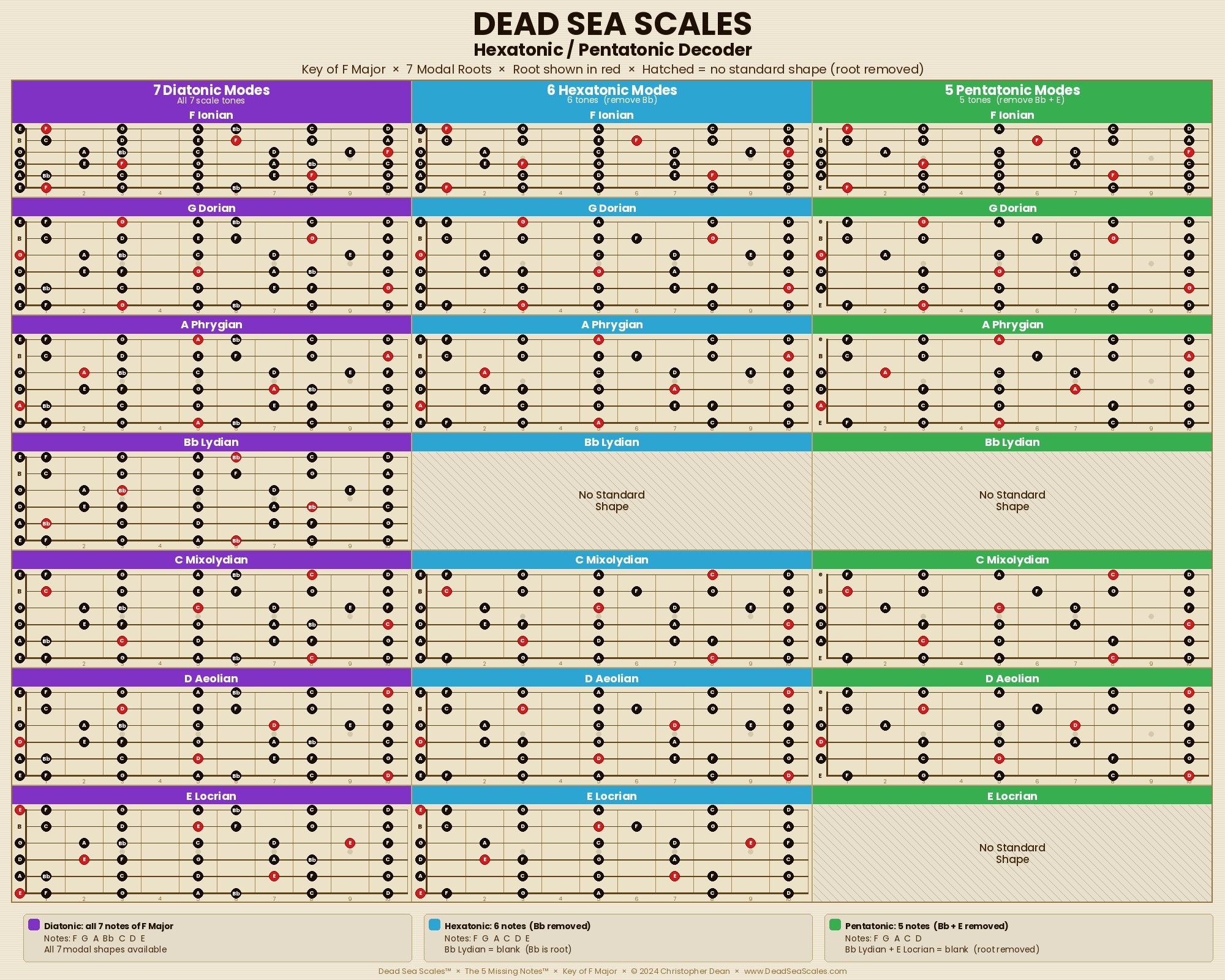
What is Diatonic, Hexatonic, Pentatonic?
These terms come from Latin: Tonic = Tone. Dia = Complete (7 notes of the major scale). Hexa = Six (6-note scales). Penta = Five (5-note scales like the pentatonic).
These terms are just some examples of how everything in music theory has more than one name. The “Musicians Code” has confused us all for way too long — and that's what Dead Sea Scales is for. You don't need to spend the next 30 years on a mountain top in Tibet, or meet Robert Johnson at the Crossroads just to find the "missing note." Follow the system step by step to unlock every note. The modes are just a framework for expression — it's the notes in-between that we feel.
Where Did the Notes Come From?
Around 300 BCE, Pythagoras noticed two blacksmiths' hammers creating a pleasing sound — one hammer twice the weight of the other (roughly 10 lbs vs 20 lbs) — striking the same anvils, they produced what we now call an octave. A perfect example: A440Hz (5th fret high E string) and A880Hz (17th fret of the same string) — one frequency exactly twice as fast as the other, visible on a sine wave or frequency chart. The Pythagoreans used the Perfect 5th and a series of equations to reveal 7 notes within each octave — the basis for the first keyboard instrument (the Hydraulis or water organ), which only had white keys. This is the origin of the phrase Diatonic or "complete tones."
The Greeks' math had a flaw called the Pythagorean comma (~23.45 cents off-tune), which produced the "Wolf Interval" — a howling dissonance. With the addition of the black keys in the 14th century (first chromatic keyboard: Halberstadt organ, 1361), a new system was needed. Vincenzo Galilei (Galileo's father) famously proposed equal temperament in 1581 — slightly nudging each interval so all keys sound equally in tune. Pythagorean temperament sounds purer but is limited in range; equal temperament allows versatility across all keys. When a guitarist bends a note to that sweet spot, they may be tapping back into those original Pythagorean ratios.
Dead Sea Scales™ · The 5 Missing Notes · By Christopher Dean
Now Available on Amazon
Dead Sea Scales™
The 5 Missing Notes
The guitar theory system that finally makes the fretboard make sense. Every scale becomes a palette when you understand the 5 chromatic notes your diatonic scale is missing — each with its own emotional colour, modal family, and expressive power.
Paperback · ISBN 9798305003093 · By Christopher Dean
What's Inside the Book
The 5 Missing Notes™ System
Each of the 5 chromatic notes explained — their emotional character, which modes they unlock, and how to use them musically.
All 7 Diatonic Modes
Complete breakdown of Ionian through Locrian with patterns, positions, and real-song examples.
Extended Modal Families
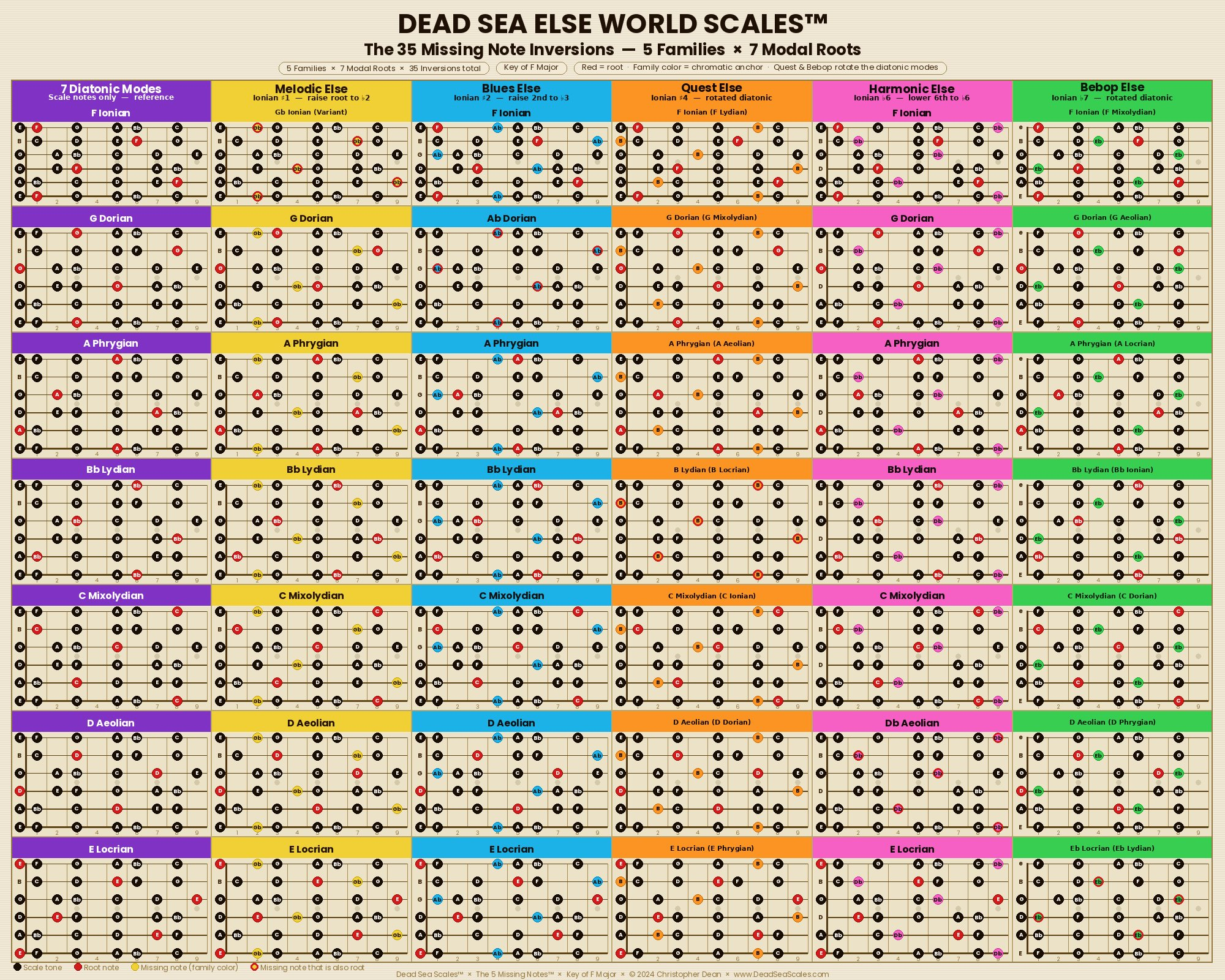
Byzantine, Melodic Minor, Persian, Harmonic Minor, Misheberak — the exotic scales hiding inside the missing notes.
Fretboard Mastery
Full-neck diagrams for every mode in every position. Stop guessing, start seeing.
Interval Relationships
Every chromatic interval mapped to emotional quality, tension, and resolution.
Pentatonic & Hexatonic Decoders
How to reduce any mode to its 5 and 6-note forms for soloing and improvisation.
Free PDF Packet
Receive the companion reference packet — printable scale decoder charts, interval maps, and the complete 5 Missing Notes™ quick-reference guide. Yours free when you join the community.
✦Pentatonic & Hexatonic Decoder (Key of F)
✦Exotic Diatonics — all 7 modes × 5 families
✦The 5 Missing Notes™ colour reference chart
✦Full-neck fretboard diagram set
✦Interval relationship quick-reference card
Send Me the Free PDF →
Instant delivery to your inbox. Unsubscribe anytime.
No spam, ever. We respect your privacy.
✦
Check Your Inbox!
Your free PDF packet is on its way. While you wait — grab the full book on Amazon.